· AI × Law · Legal Education
How Should We Train Lawyers for an AI-Driven World?
How should we train law students and junior lawyers to develop the right skills for an AI-driven world?
I recently came across Dr. Thibault Schrepel's paper offering some concrete data on this issue.
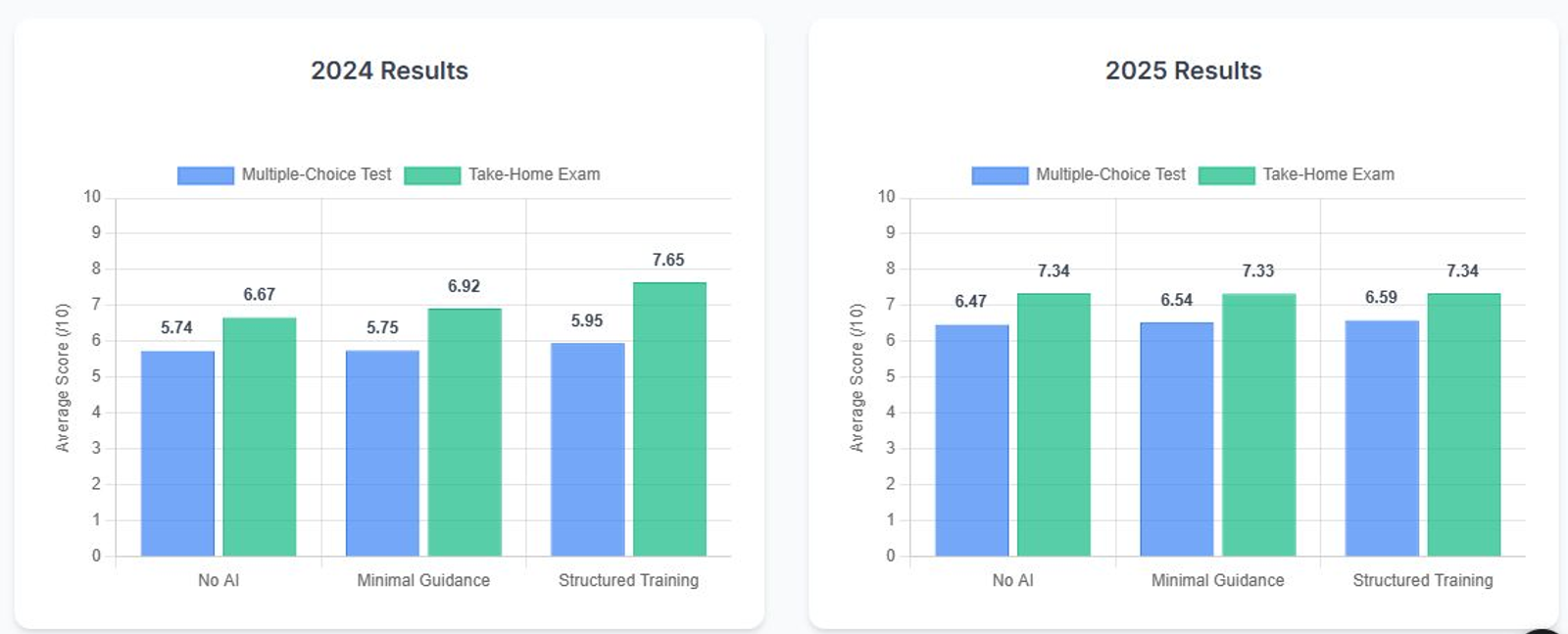
Students were divided into three groups:
Group 1 ("No AI"): Explicitly forbidden from using ChatGPT.
Group 2 ("Minimal guidance"): Allowed to use ChatGPT, but no training was provided.
- Group 3 ("Structured training"): Allowed to use ChatGPT and received a tutorial on prompt engineering.
The experiment assessed the impact of teaching methods around ChatGPT through a timed legislation refinement assignment. It also assessed the impact of AI on student learning through a multiple-choice test (MC) and a take-home exam.
The results for the MC and take-home exam showed a clear difference between the groups in 2024. Whereas, interestingly, the performance gap nearly vanished in the 2025 results, likely due to the general familiarity with AI tools.
However, it is clear that "prohibiting AI leaves students ... at a disadvantage, while integrating [AI] into legal education ... enhances performance."
What does this mean for the future of legal training?
I believe we're witnessing a fundamental shift in how legal work is done, and the existing legal education framework needs to adjust to accommodate this change.
Some thoughts on how we can do this:
The primary role for junior lawyers is shifting from pure drafting to sophisticated review and refinement.
The key value-add is no longer starting from a blank page, but in the ability to critically direct, question, and enhance an AI's work product.
Law schools must teach students to become AI critics - spotting issues in generated drafts, mastering AI-assisted research and synthesis, and developing an eye for contractual gaps and inconsistencies that slip past algorithms.
Both law firms and law schools must upgrade their training programs to build these essential new competencies. Incorporating things like structured AI prompt libraries, supervised AI drafting exercises, and mentorship focused on teaching critical AI review skills.
I'm curious to hear from others: How do you see legal training evolving, and what's one way you're already using AI in your work or studies?
Further reading:
From the post
References & resources