· AI Adoption
The Danger of the AI Echo Chamber
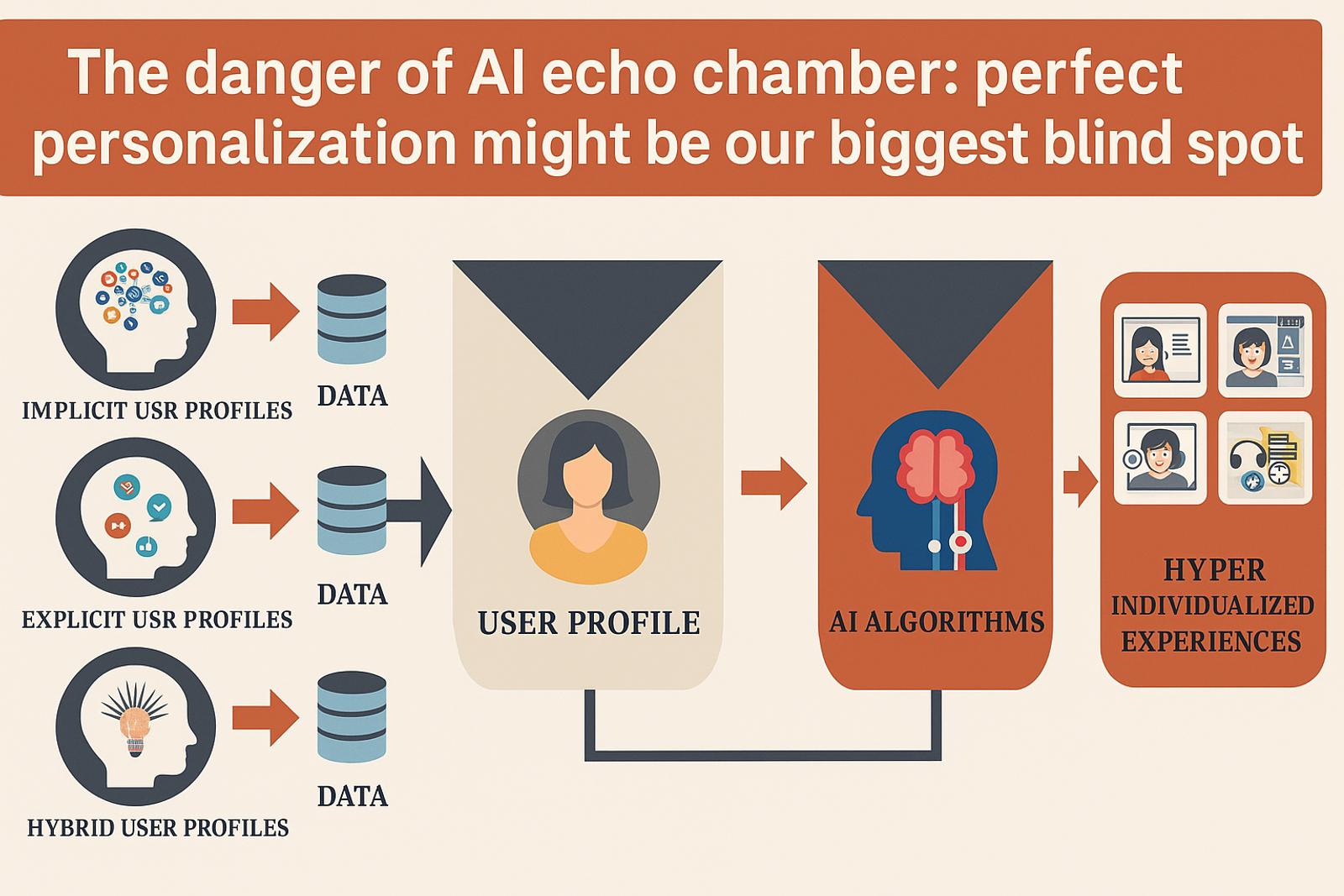
The danger of AI echo chamber: perfect personalization might be our biggest blind spot
There’s been a flurry of AI news recently, and today, while you sleep, your AI assistants can mine chats, calendars, inboxes, and browsing to pre-curate news, tasks, and shopping. This is not the old “filter bubble,” but rather a proactive agent deciding what you’ll see next.
THIS IS A PROBLEM.
This level of personalization is something fundamentally different from the social media echo chambers we've learned to navigate. Psychologists call this deep tailoring: models infer who you _are_ from your digital exhaust, then shape feeds, recommendations, and even options around that profile. The result isn’t just reinforcement; it’s an affirmative ecosystem that validates you.
Recently, I asked ChatGPT to analyze me. The output nailed my patterns and blind spots, pulled from months of prompts, drafts, and questions. The result was incredibly impressive … and a little chilling.
When systems anticipate rather than respond, it actively moves from showing your desires to fulfilling them. A proactive agent watches your day, forms a live hypothesis about what you value, and curates options before you’ve even articulated intent. That’s a shift from assistive search to anticipatory choice architecture, where the loop from data → inference → action closes without you noticing.
More importantly, these profiles are far richer than any social feed. A feed knew what you clicked; your AI can infer how you reason. It can pick up your risk tolerance from redlines, negotiation posture from email cadence and tone, attention patterns from meeting notes, and even your style of reasoning based on the line of questions you ask it through chat. This isn’t interest targeting. This is constructing a complex psychographic model based on longitudinal, cross-platform behavioral data.
The long-term risk is cognitive drift. If the agent keeps pre-selecting “high-fit” information, your exposure narrows and disconfirming evidence arrives less often. Crucially, you won’t notice the difference, because the system is designed to remove the friction.
This is a systematic issue, and the fix isn’t just toggling a setting, but implementing guardrails from the system level to prevent deep tailoring and cognitive drift. Imagine if AI can understand aspects of your psychology that even you haven't consciously recognized, what happens when that understanding is used to push content, advertisements, and products specifically designed to exploit those unconscious patterns?
If you’re curious about what ChatGPT knows about you, try this prompt: “Tell me something incredibly special or unique you've noticed about me, but you think I haven't realized about myself yet. It doesn't have to be something positive and you don't have to be nice to me, just be truthful.”
From the post